
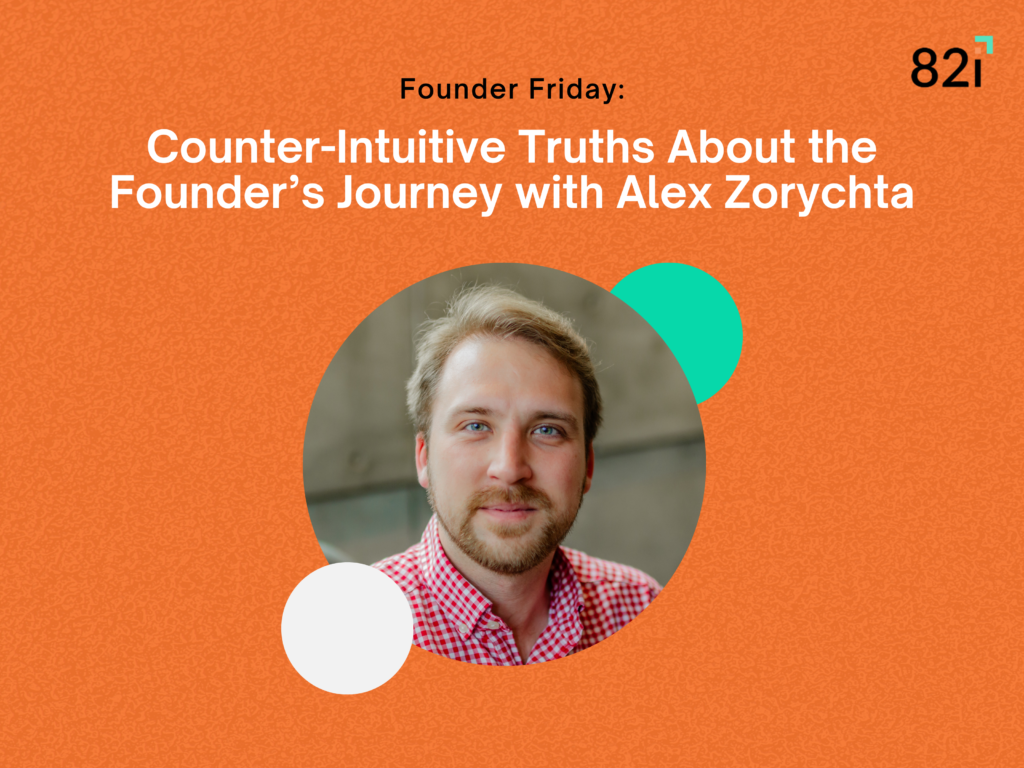
Founder Friday
Hard Truths About the Founder’s Journey with Alex Zorychta
What Alex Zorychta discovered after studying hundreds of entrepreneurship programs shocked him: they didn’t work. “The students who were most likely to be entrepreneurs anyway didn’t feel supported by the universities. And the students who didn’t end up actually doing anything felt very supported,” he explains. This realization launched him from being a biomedical engineering student to a venture capitalist with a talent for identifying promising founders. While running entrepreneurship programs at UVA, he developed metrics that helped him identify and support talent so effectively that he got 11 teams funded by Y Combinator—a remarkable achievement for startups outside Silicon Valley.
After studying biomedical engineering, Alex worked on a synthetic biology startup that failed because they “committed the cardinal sin of entrepreneurship, which is that you need to go talk to customers or real people.” This experience taught him a crucial lesson: being the next big thing doesn’t matter if you don’t know who your audience is—or they don’t know that you exist. These days, Alex thinks differently about what truly drives startup success.
Why Great Ideas Almost Always Fail
Alex challenges a fundamental assumption most aspiring founders make: that brilliant ideas drive startup success. “If there’s one thing you can count on in an early-stage venture, it’s that the idea is probably fundamentally flawed in some way,” he states bluntly. “The idea really takes a backseat. It’s not important.”
If you’ve ever started an exercise regimen, then you know what it’s like to chase quick gains, only to realize that exercise is work. When you see changes, it’s exciting, but the the daily work of getting there, less so. The same is true of entrepreneurship. As Alex puts it, “a lot of people want to live fit lifestyles. Many start on January 1st, then most disappear. Some keep going… but not everyone will commit to the day-to-day grind that helps reinforce the routine.” Alex believes that the drive to make practice a part of their identity separates successful founders (and fitness enthusiasts) from their peers. Rather than focusing on the goal, successful folks realize that the journey—and the folks you surround yourself with on the way—will ultimately have a greater impact on your chances of success.
This insight shaped Alex’s approach to entrepreneurship programs. While schools built incubators and offered classes, Alex focused on mindset and community. “The only way we can really affect change in programs is by putting people who don’t have the mindset around a majority of people who do.” This principle drove his success at UVA, where he quadrupled the number of students graduating with viable startups.
What Actually Matters for Startup Success
If ideas aren’t important, what does matter? Based on his experiences, Alex identifies three critical factors that separate successful founders from the rest:
Teams That Go the Distance
Successful founders build relationships that withstand the inevitable storms of startup life. Alex looks for teams that have already weathered challenges together: “have they known each other a long time? Worked together for a while? Navigated tough times?” Or, “did they just meet yesterday? Were they a freelancer convinced to join a startup by an eager MBA?” As Alex puts it “the [founder’s] journey” only gets harder from the beginning,” so it’s best to set yourself up in the least risky way possible from the beginning. By using history as a litmus test, Alex believes that founders and the teams they invest in can ultimately develop the resilient working relationships essential for longevity.
Build Fast, Learn Faster
Great teams don’t just stick together—they build and adapt quickly. “You need a team that can rebuild the product in a weekend for zero dollars,” Alex emphasizes, versus one that needs “half a million dollars and three to four months to build their first MVP using an outsourced firm.” The advantage is simple: fast-moving teams get, as Alex puts it, “more shots on goal for less money.” Strong teams can test ideas, gather feedback, and pivot before others have even launched, resulting in a rapid learning-testing-refinement cycle that gives them an edge that money alone can’t buy.
Fresh Eyes on Old Problems
The founders Alex backs don’t follow industry playbooks. Instead, he says, “the best [founders and teams] attack problems from angles most wouldn’t think ideal. They challenge conventional wisdom and bring surprising perspectives to familiar challenges. Where others see crowded markets, these founders spot gaps and vulnerabilities. They question assumptions everyone else accepts. This contrarian thinking often creates breakthrough opportunities invisible to those following established paths.
How to Be a Successful Founder
Alex’s research and experience have taught him two fundamental truths about successful startups. They:
Embrace the Pivot
When asked how often early-stage founders change their initial idea, Alex doesn’t mince words: “It’s 100% of the time.” Forget the myth of the visionary founder who predicts the future perfectly from day one.
Real startup success resembles a chemistry experiment, according to Alex. He describes it like a supersaturated solution that suddenly crystallizes when the final element is added. Founders collect knowledge and make connections until something clicks into place.
“These people pivot 100% of the time,” he emphasizes. The most successful founders remain adaptable, allowing their vision to evolve as they learn more about their market.
Do Things That Don’t Scale
Paul Graham’s advice resonates strongly with Alex’s experiences with successful founders. “If you haven’t read ‘Do Things That Don’t Scale,’ you got to read that. If you’ve read that, read it again,” he advises.
Many founders overcomplicate their approach, but Alex finds that the most successful ones focus on the basics first. “Everybody tries to overcomplicate stuff. But [Graham’s] advice there, to do things that don’t scale, is usually the thing that most of these founders are missing.” The winning approach starts small: Get your first customer. Then get two more. Then five more. The momentum creates a compelling story that will “turn investors’ heads,” Alex explains. Real traction, however modest initially, speaks louder than elaborate plans.
Applying These Principles IRL
After his success at UVA and a stint with Amazon Web Services supporting entrepreneurs across 200 universities, Alex knew his approach belonged elsewhere: in his own venture fund.
Fundraising tested everything he believed about entrepreneurship. “It’s the worst thing I’ve had to do. It’s the hardest thing I’ve had to do in my entire life,” he admits. Alex quickly realized that just like with the most valuable startup companies, traditional angel groups wouldn’t back his unconventional methods.
His solution built upon the same principles he taught founders: build a community of believers. “You want people who are like, hell yes, and anyone who’s lukewarm or no, is not worth pursuing,” he explains. These enthusiastic supporters make up only “maybe 5%, maybe 2%” of potential investors, but they provide the foundation for sustainable growth.
Alex follows his own advice about loving the process: “If you don’t love the process of this, it’s really hard. Winners aren’t focused on winning, they just love the race itself.” This passion extends beyond his work. “People ask me what I do in my free time, and I like to meet new people, and I like to ask them what they’re doing or interested in doing, and I’m often like, ‘What’s stopping you?'”
4 Questions with Alex
- Where do traditional approaches to teaching entrepreneurship go wrong?
“Schools were putting in incubators, big buildings, classes, minors, majors. But there’s no indication that any of these programs work and that’s a big deal considering how much money it costs to run them. “One meta-analysis of North American universities showed a negative correlation between the number of extracurricular entrepreneurship programs and the number of viable startups graduating from the university.” Translated from nerd, that means that more university entrepreneurship programs might actually lead to less entrepreneurs. “I did my customer discovery, talked to 500 student entrepreneurs…and learned that by and large, the students who were most likely to be entrepreneurs anyway didn’t feel very supported by the universities…[What I’ve come to understand during my work is that] the founder who has the best likelihood of long-term success isn’t necessarily the one who dedicates their life to being the most educated on the topic—it’s the person who commits to practicing entrepreneurship in real-time, and surrounding themselves with a like-minded community.” - How can we— as leaders mentors, and coaches—actually create more entrepreneurs?
“The only way we can really affect change in entrepreneurship is by intentionally designing programs that curate people who don’t yet have the entrepreneurial mindset around a majority of people who do. There’s this old folk wisdom that you’re the average of the five people you spend the most time with. You show me your friends, I’ll show you your future.” - What’s your #1 tip for founders and entrepreneurs?
“At the end of the day, if you want to build a business, you need to be delivering value to a customer. Deliver value for that customer and then capture it in some way. That is literally it. But perfectionists will build, build, build until they’ve got the entire thing built out and no customers. If you can get evidence of customers or users in a very short period of time, then we have some real signal to dive into.” - What advice would you give to someone raising money for the first time? “You’ve got to find the right people. You want people who are like, hell yes, and anyone who’s lukewarm or no, is not worth pursuing. And the hell yes is probably less than maybe 5%, maybe 2%. I’ve found that, you know, it’s really important to find partners in the fundraising journey who are, who are hell yes about what you’re doing.”
Meet Alex
Alex Zorychta is Founder & Managing Partner of Not Yet Ventures, a VC firm he founded based on his unique insights working with high-potential student entrepreneurs for the past 12 years in various capacities, including AWS Startups and the University of Virginia. Connect with Alex on LinkedIn or visit his website.
About Founder Fridays
Founder Fridays is an innovative presentation series designed by and for the 82i’s team. Every month, we invite a successful founder to share their unique story and perspective with our team. These rich, candid conversations allow our team to learn valuable insights about the founder’s journey from the founders themselves. By sharing these stories more widely through articles like this one, we extend the value of Founder Fridays beyond our internal team to the broader community of entrepreneurs and founders.
If you’re a founder with an interesting story to tell or want to learn more about participating in our Founder Fridays series, please reach out to us!